You're growing. Your share isn't.
Revenue is ahead of last year, so the review goes well. But the category grew faster, and growing at the same rate as the market you compete in is a slow way of standing still.
Increase Market Share
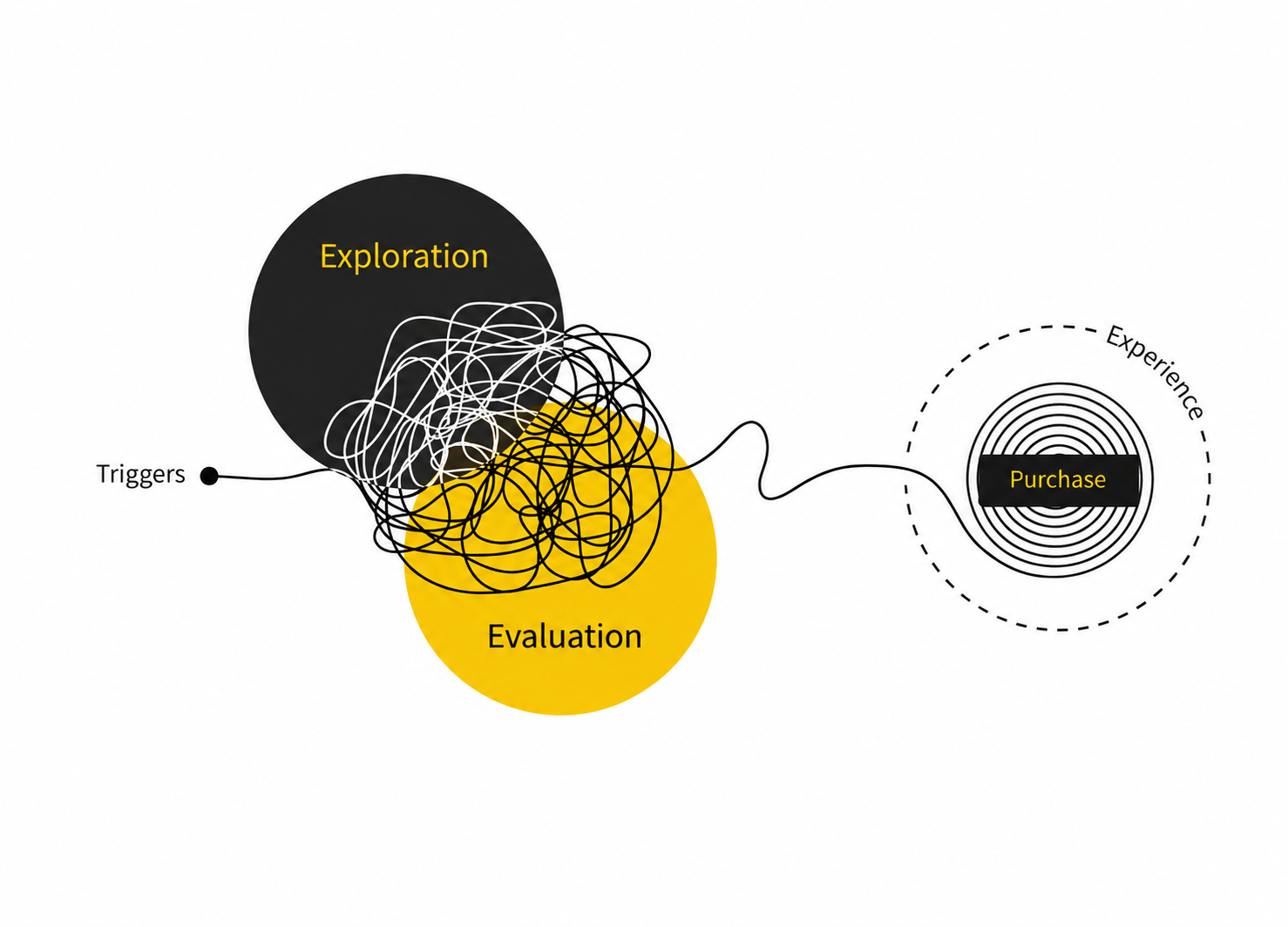
Your share of a category is the sum of how often you are one of the names considered when someone finally decides to buy. That mental availability, meaning how readily your brand comes to mind and whether you make the consideration set, is built months before anyone buys, across search, AI answers, trade media, peer conversations and comparison sites. If your competitors own more of those moments than you do, they own more of the category than you do.
Polaris makes B2B and Ecommerce brands present through the whole buying journey, not just on the channels you already track, so you win more of the buyers your competitors can’t see coming.
If any of these sound familiar, you are not alone. Every number on your dashboard can be up while your position in the category quietly falls.
Revenue is ahead of last year, so the review goes well. But the category grew faster, and growing at the same rate as the market you compete in is a slow way of standing still.
Named in the AI answer. Quoted in the trade press. Top of the comparison page. Not because their product is better, but because they are present in more of the places your buyer forms a view.
When you are one of several unfamiliar options, you pay to be considered. When you are the name people already recognise, consideration costs you nothing. Rising cost per acquisition is usually a position problem wearing a media costume.
“What is our share, and is it moving?” Nobody in the room knew, because share is the one commercial outcome that does not appear in your analytics platform.
Liquidline was competing in a crowded category where buyers were researching, comparing and forming preferences before speaking to sales. Polaris built a joined-up digital marketing strategy that increased visibility across the buying journey and helped turn that attention into commercial opportunity.
/ 550% increase in market share
/ More new-business first appointments
/ A busier sales team
Read the Liquidline case study
1400 %
increase in MQLs · 62% reduction in cost-per-lead · 2.5x users
5 X ROI
420% increase in leads · 670% increase in traffic
60 £m
generated in pipeline value
Win moments a named competitor currently owns. Finite, zero-sum, and faster to show in the numbers because the demand already exists. It also puts you in a direct fight, which is fine when the category is mature and you know exactly who you are fighting.
Reach the audiences, needs and use cases in your category that are not buying from anyone yet. Slower to register, far larger ceiling, and you capture a disproportionate share of the demand because you were the brand that defined it.
The evidence
NB: None of the below is projected. It is the mechanism your growth plan is already subject to.
01
Across automotive, energy and mobile handsets, a brand’s share of category brand searches correlated with its market share and moved ahead of it. (Binet, IPA EffWorks 2020)
02
Share of search leads share of market by roughly six to twelve months, depending on the length of the buying cycle. Your relative position is visible long before it reaches your revenue. (Binet, IPA EffWorks 2020)
03
Research across 30 cases in 12 categories and seven countries found share of search accounted for around 83% of a brand’s market share. (Hankins, IPA)
04
Businesses running five omnichannel growth strategies together were twice as likely to gain market share as those relying on one. (McKinsey B2B Pulse)
05
B2B businesses with the strongest omnichannel experiences improve market share by around 10% a year. (McKinsey)
06
Category leaders earn over eight times more citations in AI answers than their direct rivals. Visibility in the answer layer is winner-takes-most. (Data-Mania 2026)
Every internal report says yes, because internal reports compare you to yourself. Measured against the category, that is a year in which you handed share to someone else while celebrating. Relative position is the only growth number that survives contact with a board.
Most leadership teams can do the first list immediately and stall on the second. That asymmetry is the whole problem. You cannot defend a position you have not measured, and the brands taking share from you are rarely the ones you benchmark against out of habit.
An AI answer, a buyer's guide, an analyst note, a peer in a Slack group. Each one is a shortlist, and each shortlist is a share allocation made before you are in the room. If the same three names keep appearing and yours is not among them, that is your market share being decided in advance.
Category demand in any period is finite. Every moment you are absent from is a moment allocated to a competitor, and they will not give it back voluntarily. Relative position is the one growth metric where doing nothing is an active decision.
Speak to our search experts
The 360 Approach
Share of a category cannot be pursued in the abstract. It needs a boundary, a named competitor set, and a way of seeing your position move before it reaches your revenue. This is the shape of a system built to shift relative position rather than absolute traffic.
01
Share is a ratio, and a ratio needs a denominator. We define the categories, segments and demand spaces you have actually decided to win, size the real demand in each using Pinpoint and Kartessien, and establish where you currently sit against a named competitor set. Without this, every subsequent number is unprovable.
02
This is not a ranking gap analysis. It is a moment-by-moment audit of where your competitor set gets discovered, cited, reviewed and recommended, across search, AI answers, trade media, communities and comparison environments. We prioritise by the commercial value of the demand behind each moment and by where a competitor is weakest, not by what is easiest to deliver.
03
Traffic volume tells you nothing about position. We track share of search against your named competitor set, share of category citations in AI answers, and share of visibility across the moments that shape consideration. Because share of search leads share of market, your relative position becomes visible six to twelve months before it reaches your sales figures. That is enough warning to act on.
Market share starts with share of consideration. Showing up across the places buyers search, ask and compare gives your brand more opportunities to enter the conversation and fewer for competitors to own it uncontested.
A useful distinction: visibility is not the same as market share. At POLARIS, we use visibility and consideration as leading indicators to identify where your brand is being included, excluded or replaced—before the commercial result becomes visible.
From growth measured against last year
From ranking against keywords
From reporting traffic
What you’ll need to be true
Search 360 is designed to create the most value where the conditions below are in place. They help us focus effort where it can have the greatest impact.
The conditions
The logic