


Quick links
Ask most food and drink marketers whether they have a content strategy and the answer will be yes. Ask them whether that content strategy is built around how their audiences actually behave across every channel they use, and the answer becomes more complicated.
The gap between having a content strategy and having a content strategy that works across the full range of modern buyer and consumer behaviour is one of the most significant sources of underperformance we see in food and drink marketing. And it applies equally to businesses focused on wholesale growth, direct-to-consumer (D2C) brand building, or both.
Why a Single Content Strategy Rarely Serves a Dual Audience
The content that works for a trade buyer researching a new supplier is fundamentally different to the content that works for a consumer discovering a new product. Not just in tone, but in format, depth, platform, and the moment in a decision journey at which it needs to appear.
A procurement manager researching ambient food suppliers is spending time on Google, asking AI tools questions, reading industry publications, and watching webinar content. They want evidence of expertise, commercial credibility, and a clear point of view on the category. They are operating primarily in search and stream mode.
A consumer discovering a new soft drink brand is scrolling Instagram and TikTok, watching recipe content on YouTube, reading reviews on retail platforms, and searching for products on Google and Amazon. They want to be entertained, inspired, and reassured. They are operating across all four modes but particularly through scroll and shop.
If you are running both strategies from a single content approach, you are almost certainly underserving at least one of these audiences, and quite possibly both.
Mapping Your Content to the Four Modes
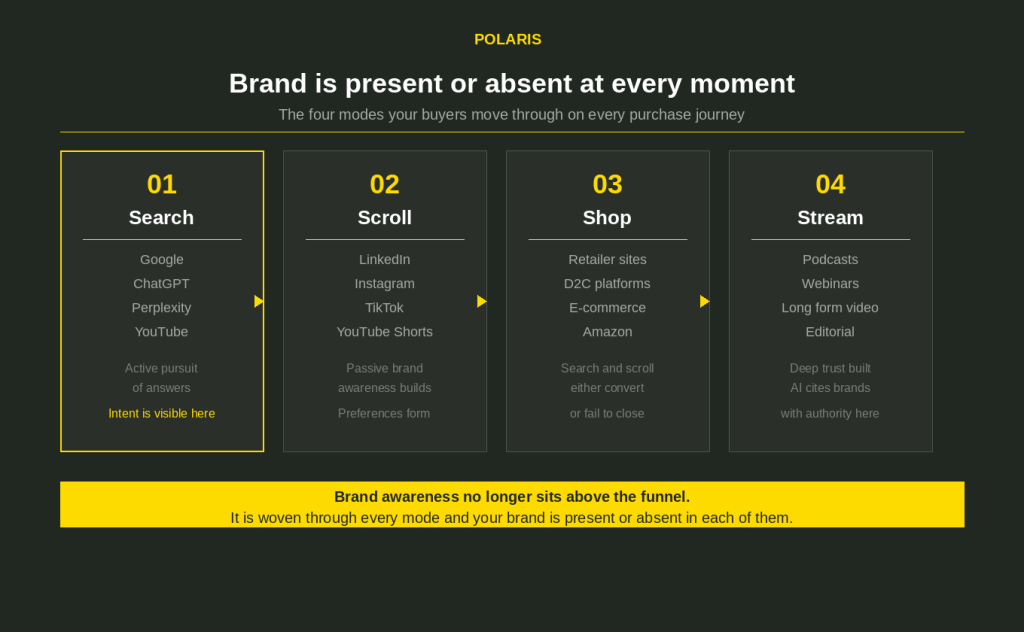
The most effective way to audit and improve a content strategy for a dual-audience food and drink business is to map what you are currently producing against the four modes of behaviour and ask honestly where the gaps are.
Search: are you answering the questions your audiences are actually asking?
Both trade buyers and consumers use search at multiple points in their decision journey. Trade buyers search to validate suppliers, understand category trends, and build business cases. Consumers search to find products, read reviews, and understand ingredients or provenance.
The question is whether your content is structured to appear in those searches. This means not just having a website, but having specific content that directly addresses the questions your ideal trade buyer or target consumer is typing into Google or asking an AI tool. In 2026, appearing in AI-generated search answers, known as AI Overviews, requires content that is authoritative, well-structured, and clearly relevant to the topic being searched. Most food and drink brands have significant gaps here.
Scroll: are you building brand presence where attention lives?
Social media scroll behaviour is where brand awareness is built and where preferences begin to form, for both trade buyers and consumers. The content that performs in scroll environments is short, visually strong, and built around a clear point of view. It is not repurposed website copy.
For trade audiences, LinkedIn is the primary scroll environment. For consumer audiences, Instagram, TikTok and YouTube Shorts are dominant. For some food and drink categories, Pinterest remains significant. The question is not whether you are present on these platforms but whether the content you are publishing is genuinely calibrated for how each platform’s audience scrolls.
Shop: does your content support conversion at the point of purchase?
Shop behaviour covers everything from retailer product pages and e-commerce listings to your own D2C platform and the content that sits around it. This is where search and scroll activity either converts or fails to close.
The content that matters here is product-level: clear descriptions, strong visual assets, reviews and social proof, and the kind of concise brand storytelling that reassures a buyer who has arrived with intent. For trade buyers, this extends to category sell-in materials and commercial case studies. For consumers, it means every touchpoint on your D2C site or retailer listing is working as hard as your advertising.
Stream: are you investing in the long-form content that builds deep trust?
Streaming and long-form content consumption, including podcasts, YouTube videos, webinars, and long-form editorial, is where sustained brand authority is built. It is the mode that most food and drink brands underinvest in and the one that increasingly determines which brands are cited in AI-generated answers.
AI tools draw on authoritative, in-depth content when constructing their responses. A food and drink brand that publishes substantive long-form content on topics relevant to both its trade and consumer audiences is far more likely to be surfaced in AI search results than one that relies solely on short-form social content.
The Connection to Organic Search Performance
Organic search engine optimisation (SEO) is not a separate channel from the four modes described above. It is the connective tissue that runs through all of them. When your brand publishes strong content across search, scroll, shop and stream, search engines and AI tools recognise that authority and reward it with visibility.
This is why we approach organic search campaigns at POLARIS as a whole-brand activity rather than a purely technical one. The brands that perform best in search are those that are building genuine authority across all four modes. The technical SEO work we do accelerates and amplifies that authority, but it cannot substitute for it.
If you are not sure how well your current content strategy is serving each of the four modes for your trade and consumer audiences, our strategy playbook includes a practical diagnostic framework you can work through for your own business.


