


Quick links
There is a conversation that comes up repeatedly in food and drink businesses, particularly those managing both a wholesale channel and a direct-to-consumer (D2C) presence. It usually sounds something like this: we need to focus on performance right now; brand is a longer-term investment we will come back to.
It is an understandable position. Budget is finite. Pressure to demonstrate return on investment (ROI) is immediate. Performance channels offer attribution that brand activity rarely does.
But in 2026, the distinction between brand investment and performance investment is increasingly a false one. And for food and drink marketers, acting as though they are separate is one of the most common and most costly strategic mistakes we see.
What Brand Actually Does in a Multi-Mode World
Brand awareness used to operate primarily at the top of a funnel. You built it through advertising, packaging, and events. It created familiarity. Familiarity created preference. Preference eventually drove purchase.
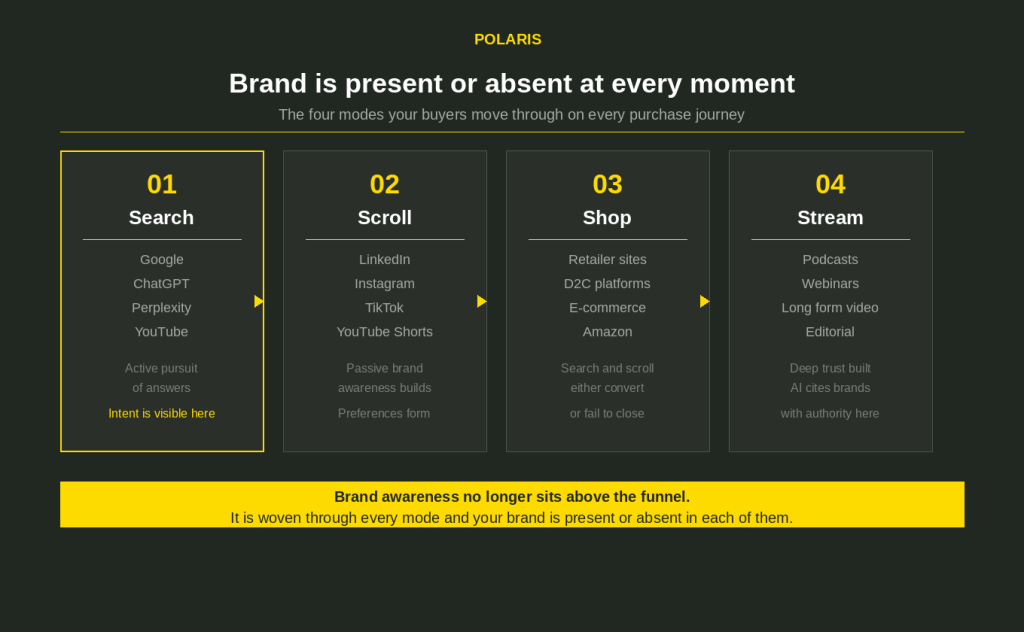
That sequence still holds. But the mechanisms through which brand awareness is built and converted have multiplied significantly. Your audiences are not experiencing your brand in one place. They are encountering it, or not encountering it, across search, scroll, shop and stream simultaneously.
For a wholesale buyer evaluating a new ambient food supplier, brand familiarity shapes which search results they click, which LinkedIn content they stop on, which podcast guests they find credible, and which website they actually spend time on. The buying process happens across all four modes. Brand is present, or absent, in each of them.
For a consumer discovering a new food or drink product, the same dynamic applies. They may first encounter your brand through a recipe video they scroll past on Instagram. They search your brand name a week later. They find you on a retailer platform. They abandon the basket. They see a retargeted ad. They convert. At no point in that journey does brand and performance operate as separate activities. They are the same activity, expressed across different moments.
The Search Problem that is Really a Brand Problem
One of the clearest indicators of brand health in 2026 is organic search performance. Not because search is the only channel that matters, but because search is where intent becomes visible.
When someone searches for a product category you operate in and you do not appear in the results, that absence reflects one of two things: either your content and search engine optimisation (SEO) strategy is not strong enough, or your brand does not have sufficient authority in that category for search algorithms and AI tools to surface it.
In most cases we see, it is both. And both are brand problems as much as they are technical ones.
Food and drink brands that invest consistently in building their authority, publishing content that genuinely serves the informational needs of their audiences, earning coverage and links from credible sources, and maintaining a clear and consistent point of view in their category, are the brands that search rewards with visibility. That visibility then drives traffic, which drives conversion, which drives revenue.
This is why we frame organic search campaigns not as a standalone channel tactic but as the performance expression of your brand strategy. The two are inseparable.
The Dual Challenge for Food and Drink Marketers
If you are running both a B2B wholesale strategy and a D2C growth strategy, the brand investment challenge is more complex than it is for businesses focused on a single channel. You are building brand authority with two distinct audiences who have different needs, different search behaviours, and different definitions of what a credible brand looks like.
A trade buyer at a national retailer wants to see category expertise, commercial credibility, and evidence that your brand will perform on shelf. A consumer wants to see product quality, brand values, and social proof from people they trust.
The good news is that a well-constructed brand strategy serves both. The content you create to demonstrate expertise to trade buyers also builds the kind of authority that consumers find reassuring. The social proof you build through consumer engagement also gives trade buyers confidence in the brand’s commercial momentum.
The key is understanding that your brand is not two different things for two different audiences. It is one brand, expressed through content and channels that are calibrated for each audience’s specific mode of behaviour and stage of decision.
Where to Start
The most practical starting point for any food and drink business trying to strengthen the connection between brand investment and commercial performance is an honest audit of where your brand is currently visible and where it is not, across all four modes.
Where does your brand appear when your ideal trade buyer searches for suppliers in your category? Where does it appear when your target consumer searches for products like yours? What content are you publishing that serves the scroll and stream behaviours of each audience? Where in the shop environment, whether physical retail, e-commerce, or your own D2C platform, does your brand presence either close or lose the sale?
The gaps in that audit are your strategic priorities. And in almost every case, organic search is both the clearest indicator of where the gaps are and the highest-leverage channel through which to close them.
Our strategy playbook walks through this audit framework in detail, with specific guidance for food and drink businesses managing single and dual channel strategies.


